Sensors, simulation and soldiers: The science behind modern military training
Written by Tom Flecchia, Capabilities Manager for Training & Simulation, Saab UK
Modern military training has evolved far beyond traditional exercises. Today's training environments combine wearable technology, vehicle instrumentation, laser simulation systems and real-time data networks to create highly realistic battlefield scenarios.
Our Training and Simulation systems enable forces to train as they would fight, while capturing detailed data on every movement, engagement and decision. The result is a safer, more cost-effective and highly immersive training environment that helps military forces improve readiness and performance.
But how does it all work?
Creating the digital battlefield
Before an exercise begins, soldiers and vehicles are equipped with a network of sensors, laser systems and communication devices that replicate the effects of real weapons and battlefield conditions.
Every participant becomes part of a connected training ecosystem. When a soldier fires a weapon, manoeuvres across terrain or engages an opposing force, the system records and analyses these actions in real time. This creates a realistic battlefield experience while providing valuable performance data that can be reviewed after the exercise.
Personal Detection Devices: Bringing realism to every soldier
What are Personal Detection Devices?
Personal Detection Devices (PDDs) are worn by each soldier participating in the exercise. These systems typically include:
- Head harnesses fitted with laser detectors
- GPS positioning technology
- A Personal Computer Unit (PCU)
- Long and short-range radio communications
- An engagement feedback device
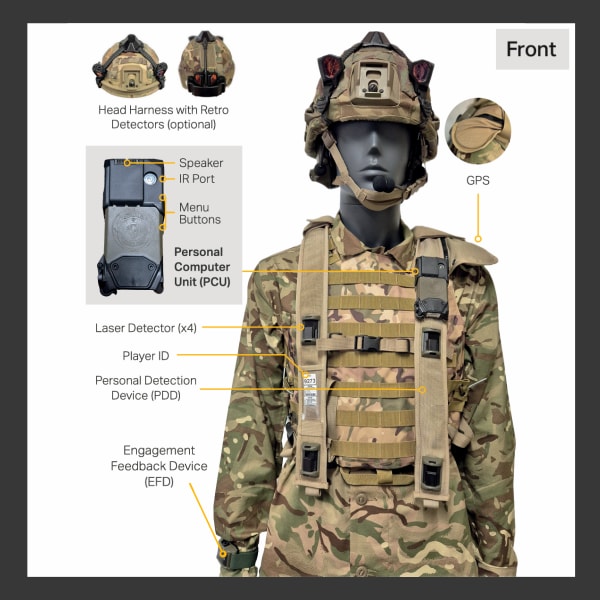
This is paired with weapon simulation systems, including Small Arms Transmitters (SATs) fitted to service weapons, and simulators for shoulder-launched weapons such as NLAW and Carl-Gustaf, enabling realistic engagement and weapon effects during training exercises.
Together, these components create both a physical and digital representation of each soldier on the battlefield.
How does a soldier hit get assessed?
When a soldier fires their weapon, the Small Arms Transmitter emits a safe Class 1 laser that accurately represents the effects of the weapon being used.
If another soldier's detectors register the shot, the PDD immediately evaluates the engagement. Rather than simply recording a hit or miss, the system calculates what weapon caused the impact and determines the likely effect.
For example, the system can distinguish between a rifle round, artillery strike or improvised explosive device (IED). Using predefined weapon-effect models, it calculates the probability and severity of the wound sustained.
The soldier then receives immediate feedback through the Personal Computer Unit, which announces the injury and its severity. Depending on the result, the system can simulate realistic battlefield consequences. A serious wound may reduce capability, while a fatal casualty can automatically disable the weapon transmitter, preventing the soldier from continuing to engage targets.
This level of realism encourages troops to react exactly as they would in real operational conditions.
Vehicle training systems: Simulating survivability and lethality
Modern exercises extend beyond individual soldiers to include military vehicles.
Our vehicle instrumentation combines two key capabilities:
-
Target Weapon Effects Simulation (TAGWES)
TAGWES equips vehicles with laser detectors and protection modelling systems that represent the vehicle's armour and vulnerability.
-
Attack Weapon Effects Simulation (ATWES)
ATWES enables different areas of the vehicle to be assigned varying protection levels, creating a realistic vulnerability template. This means that where a vehicle is struck and what weapon is used can influence the outcome of the engagement.
It also allows vehicles to engage other targets using compact ballistic laser technology that accurately represents a vehicle's weapon systems.
When combined with TAGWES, the result is a realistic interaction between attacking and defending platforms. Rather than relying on subjective assessment, engagement outcomes are calculated automatically using the system's weapon-effect algorithms.
This creates confidence that training outcomes reflect realistic battlefield conditions.
EXCON: The digital nerve centre of the exercise
At the heart of the training environment sits EXCON, short for Exercise Control.
At the centre of major exercises is the Exercise Control Centre (EXCON) – the hub responsible for planning, managing and evaluating training activity.
EXCON acts as the command and analysis hub for the entire exercise. Through a secure network, data from soldiers, vehicles and battlefield controllers is collected and monitored in real time.
Every movement, engagement, casualty and tactical decision can be viewed as the exercise unfolds.
For exercise planners and military leaders, this level of visibility provides an unprecedented understanding of what is happening across the training area. It also allows specific events, injects and scenarios to be introduced as required, helping maintain training objectives and realism.
Battlefield oversight and intervention
Training exercises are also supported by specialised tools used by observer controllers.
-
Military observer controller
Observer controllers use a battlefield awareness tablet that provides a comprehensive view of the exercise. This allows them to monitor activities, validate training objectives and assess unit performance in real time.
-
Control gun
A control gun provides exercise staff with the ability to wound, kill or reset players during training. This can be used to simulate, casualties or scripted scenario events that help shape the exercise and reinforce learning objectives.
These tools ensure the training environment remains dynamic, realistic and responsive.
Turning data into learning
Perhaps the most powerful aspect of modern training and simulation is what happens after the exercise ends.
Because every action has been digitally captured through the PDDs, vehicle systems and EXCON network, Saab analysts can generate detailed After-Action Reviews (AARs).
Commanders and soldiers can replay events, examine key decisions and understand exactly what happened during critical moments. Rather than relying solely on personal recollections, they can use objective data to identify strengths, weaknesses and opportunities for improvement.
This transforms training from a single event into a continuous learning process.
Modern training and simulation systems combine wearable soldier technology, vehicle instrumentation, real-time exercise control and data analytics to create highly realistic battlefield experiences. By accurately replicating weapon effects, tracking battlefield activity and capturing objective performance data, these systems help military personnel train more effectively and safely.
The result is a training environment where soldiers can learn from realistic scenarios, commanders can make informed decisions, and armed forces can build greater operational readiness for the challenges of the modern battlefield.